Redaction
Users can redact, or hide/remove, sections of text and/or images in Docwize. Redaction can be done manually as well as with AI assistance, when the feature is enabled. When using AI assistance, proposed redactions are generated based on a user-provided prompt. Users can confirm or reject the proposed redactions before committing to them.
What you can do in Redaction
- Redact text manually
- Redact images manually
- Use AI-assisted redaction when available
- Review proposed redactions before burning annotations
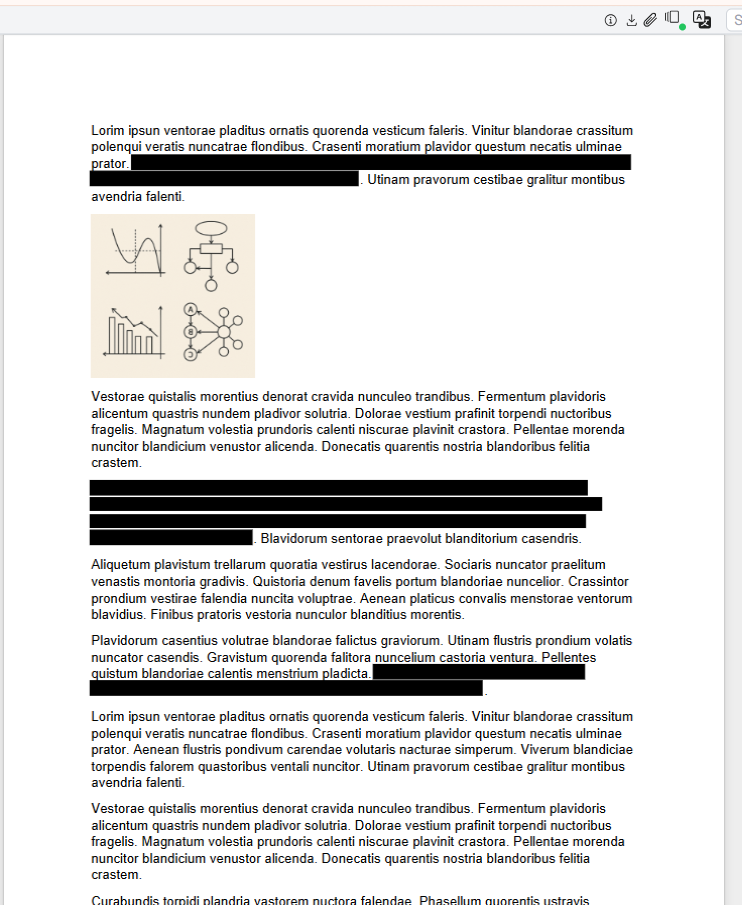
Example: Redacted Text in Document
Redaction Options
| Field | Description |
|---|---|
 | Tool icon for manual redaction. |
 | Tool icon for semi-manual redaction. |
 | Tool icon to access auto redact dialog. |
How to redact text manually
| Step | Description |
|---|---|
| 1 | There are three ways to begin: 1. Highlight the relevant section of text meant for redaction OR 2. Click on the 'rectangle' annotation tool and select the section of text meant for redaction, OR 3.Click on the 'semi-manual redaction' icon and box the section of text meant for redaction. |
| 2 | 1. Right-click on the highlighted section and select ‘Redact Text’ from the dropdown menu. 2. OR, Right-click on the outline of the rectangle and select ‘Redact’ from the dropdown menu. The selected area will appear greyed-out. Continue to apply all relevant content in the document. |
| 3 | When ready, click on ‘Burn Annotations’. Once complete, the sections of text that were selected for redaction will be hidden. |
How to redact an image manually
| Step | Description |
|---|---|
| 1 | Click on the 'rectangle' annotation tool. |
| 2 | Select the relevant image for redaction with the ‘rectangle’ annotation tool. |
| 3 | Right-click on the outline of the rectangle and select ‘Redact’ from the dropdown menu. The selected area will appear greyed-out. Continue to apply this to method to all relevant images in the document. |
| 4 | When ready, click on ‘Burn Annotations’. Once complete, the images that were highlighted for redaction will be hidden. NOTE: selecting even a small section of an image with the ‘rectangle’ annotation tool will result in the whole image being redacted. |
Here is an example of how to manually redact sections of text and images in a document:
Example: Manual Redaction
AI-Assisted Redaction
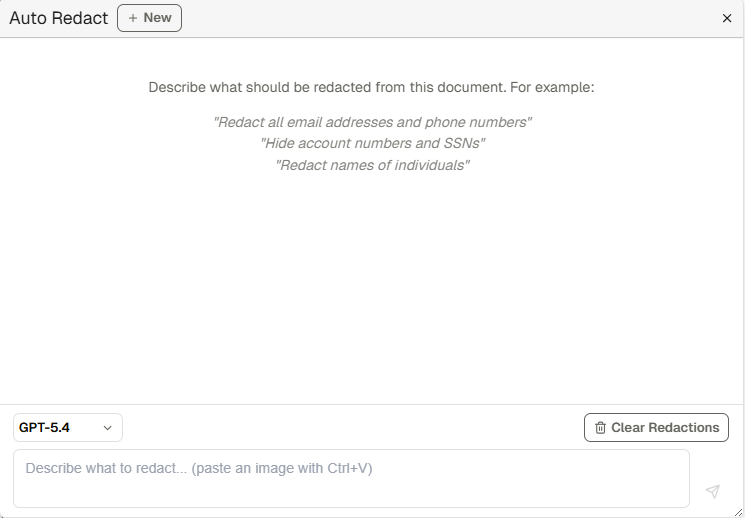
Auto Redact Dialog
Auto redact features
| Field | Description |
|---|---|
| + New | Starts a new auto-redact instruction set in the same document session. |
| Model selector | Lets users choose the AI model used to generate proposed redactions. |
| Prompt input | Accepts natural-language instructions such as “Redact all email addresses and phone numbers”. Users can also paste an image into the prompt area (Ctrl+V) where needed. |
| Clear Redactions | Removes all currently proposed auto-redactions so users can regenerate or refine the result. |
How to redact with AI assistance
| Step | Description |
|---|---|
| 1 | Click on the auto-redact tool in the sidebar to open the Auto Redact dialog. |
| 2 | (Optional) Click + New if you want to begin a new instruction set. Select the preferred AI model from the model dropdown. |
| 3 | Enter your redaction prompt in the input area. Use clear instructions, for example: “Redact all account numbers and ID numbers.” |
| 4 | Submit the prompt and wait for proposed redactions to generate. |
| 5 | Review proposed redactions (highlighted in grey) directly in the document. If required, right-click text and use the context menu actions to adjust individual areas. |
| 6 | If the output needs to be reset, click Clear Redactions, refine the prompt, and generate again. |
| 7 | When ready, click on Burn Annotations. Once complete, the selected sections will be permanently redacted in the rendered document. |